
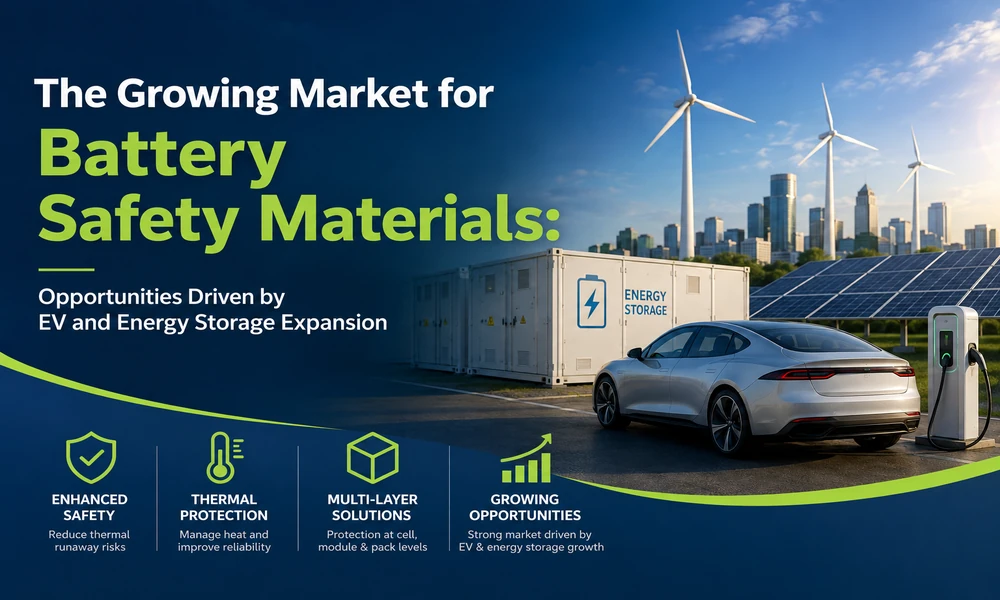
The rapid expansion of electric vehicles (EVs) and battery energy storage systems (BESS) is creating a major downstream opportunity that receives less attention than battery cells themselves: lithium battery safety materials.
As battery packs become larger, more energy-dense, and more widely deployed, manufacturers can no longer treat thermal insulation, flame retardancy, electrical insulation, cushioning, and thermal propagation protection as secondary design considerations. These functions are increasingly becoming integral parts of battery system architecture.
Together, these trends are expanding the addressable market for materials designed to make battery systems safer.
EV and Energy Storage Growth Creates a Larger Safety Materials Market
The relationship between battery deployment and safety-material demand is straightforward: more battery cells installed in vehicles and stationary storage systems mean more cells, modules, and packs that require protection.
The scale of this expansion is already significant. The total volume of batteries used in the energy sector exceeded 2,400 GWh in 2023, approximately four times the level recorded in 2020. EV applications represented more than 90% of battery use in the energy sector that year.
Stationary storage represents another important growth engine. Battery systems are increasingly being deployed alongside renewable energy projects, industrial facilities, commercial buildings, data centers, and electrical grids.
Looking toward 2030, the opportunity becomes even larger. Under the IEA’s Net Zero Emissions scenario, battery storage capacity would rise fourteen-fold to around 1,200 GW by 2030.
For battery safety material suppliers, therefore, the opportunity is not tied to one application. It spans two enormous electrification markets simultaneously: transportation and stationary energy storage.
Safety Is Becoming a Materials Engineering Challenge
Increasing battery deployment does not automatically translate into demand for every material supplier. The more important market shift is that battery safety requirements themselves are becoming more sophisticated.
A modern lithium-ion battery system must manage several risks at the same time:
- electrical short circuits and insulation failure;
- heat accumulation during operation;
- mechanical vibration, shock, and compression;
- flame exposure;
- thermal runaway propagation from one cell to neighboring cells;
- structural deformation during abnormal conditions.
This changes how safety materials are evaluated.
Rather than asking simply whether a material is “flame retardant,” battery designers increasingly need to consider a combination of thermal conductivity, electrical insulation, compression behavior, temperature resistance, flame resistance, thickness, weight, durability, and manufacturability.
As a result, battery safety materials are moving from commodity components toward application-specific engineered solutions.
Opportunities Exist at the Cell, Module, and Pack Levels
One particularly important characteristic of the battery safety materials market is that protection is required across multiple layers of the battery architecture.
Cell-Level Protection
At the cell level, electrical insulation and flame-retardant materials can help separate conductive components and reduce electrical safety risks.
Materials such as PC insulation flame-retardant sheets can therefore play an important role where battery manufacturers require a combination of electrical insulation, mechanical stability, and flame-retardant performance.
As battery architectures become more compact, thin materials capable of delivering multiple functions without consuming excessive pack space could gain increasing commercial value.
Module-Level Thermal Protection
The module level presents an even broader materials opportunity.
Once abnormal heat develops in a cell, preventing or delaying heat transfer toward adjacent cells becomes critical. This creates demand for materials positioned between cells, around modules, or in other thermal-barrier locations.
- CR foam for cushioning, sealing, vibration management, and insulation;
- nano silica composite thermal insulation boards for high-performance thermal barriers where very low heat transfer is required;
- ceramifiable silicone foam, which can combine elasticity during normal operation with enhanced thermal and fire protection under extreme-temperature conditions.
The commercial opportunity increasingly lies in combining multiple functions rather than optimizing only one parameter.
Pack-Level Protection Opens Another Market
Battery packs must survive not only thermal events but also vibration, mechanical loading, environmental exposure, and long operating periods.
This creates another market for multifunctional materials such as PIR thermal insulation cushioning boards, which can contribute to thermal insulation while also providing mechanical cushioning and structural protection.
For stationary energy storage systems in particular, pack- and system-level thermal management becomes important because hundreds or thousands of cells may operate together within cabinets or containers.
The growth of utility-scale storage therefore creates demand not simply for more batteries, but for more complete thermal propagation protection systems.
From Selling Materials to Solving Thermal Propagation Problems
One of the most important business opportunities for suppliers is the transition from individual-material sales toward battery safety solutions.
Traditionally, a supplier might sell foam, insulation sheets, or thermal boards based primarily on specifications such as thickness, density, thermal conductivity, or flame-retardant rating.
Battery manufacturers, however, ultimately care about system-level questions:
- Can the material help slow heat transfer?
- Can it maintain insulation performance during a thermal event?
- Can it accommodate cell expansion?
- Can it reduce vibration during vehicle operation?
- Can it provide sufficient protection without adding excessive thickness or weight?
This creates room for suppliers that can recommend different material systems according to cell chemistry, cell format, battery architecture, operating environment, and required safety performance.
The competitive advantage shifts from simply “we manufacture insulation material” toward “we help engineers design the appropriate protection system.”
The Market Opportunity Is Moving Beyond Volume
The expansion of EVs and energy storage certainly increases the physical volume of materials required. But the more significant opportunity may come from the increasing value of safety per battery pack.
Battery safety is evolving from a single-component issue into a multi-layer engineering system:
Cell level → electrical insulation and localized protection
Module level → cushioning, thermal barriers, flame resistance, and thermal propagation control
Pack level → thermal insulation, mechanical protection, and system-level safety
This creates opportunities across an increasingly diverse material portfolio.
Suppliers capable of integrating PC insulation flame-retardant sheets, CR foam, nano silica composite thermal insulation boards, ceramifiable silicone foam, PIR thermal insulation cushioning boards, and other specialized materials can address different failure modes at different levels of the battery system.